Sydnor G. Ferguson
Sydnor Gilbert “Syd” Ferguson was born in Fauquier County, Virginia, the youngest of three brothers. His year of birth is uncertain. Some sources give 1845, while his gravestone records November 12, 1846.
Ferguson was a cousin of Amanda “Tee” Edmonds of Belle Grove. Edmonds kept a diary from 1859 to 1867, later published in book form. Her entries place Ferguson and his brothers within the social world surrounding Belle Grove during the war. Mosby’s Rangers were frequent visitors, and Edmonds repeatedly referred to Syd and his brothers as “the Ferguson boys.” Her own brothers also served in the Virginia cavalry.
In the fall of 1863, Ferguson enlisted as a private in Company B, 43rd Battalion Virginia Cavalry, Mosby’s command. He remained with the Rangers through the end of the war and was paroled at Winchester in April 1865. One surviving description gives Ferguson as six feet tall, with brown hair and hazel eyes. He was therefore nearly the same height as Lewis Powell.
His service was interrupted almost at once. During a skirmish near Chain Bridge in November 1863, Ferguson was shot in the right arm and did not return to duty until February 1864.
He rode a swift mare named Fashion. Later accounts have sometimes confused Ferguson’s horse with the celebrated American racehorse of the same name, but that animal died around 1860.
Ferguson appears most prominently in accounts of the fight with Captain Richard R. Blazer and his scouts near Kabletown on November 18, 1864. According to later accounts, four Rangers pursued Blazer as he attempted to escape: Ferguson, Lewis Powell, Samuel Alexander, and Henry Cabell “Cab” Maddux. Ferguson overtook the captain and drew alongside him. With his ammunition exhausted, he struck Blazer with his weapon and knocked him from the saddle.
Nearly four decades later, the Blazer fight remained vivid. In 1903, Ferguson met John S. Mosby at the unveiling of the Mary Washington monument in Fredericksburg. Mosby later wrote that the two had talked about their years with the Rangers and, in particular, the capture of Blazer.
Ferguson’s postwar life followed a very different course. He resumed his education, studied at Randolph-Macon College, and entered the Methodist ministry. He spent most of the rest of his life serving various congregations. He married in 1873 and remarried in 1898.
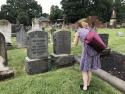
Ferguson died suddenly in Leesburg on March 7, 1904, and was buried at Edge Hill Cemetery in Charles Town, West Virginia, beside his first wife and some of their children.
How closely Ferguson knew Lewis Powell cannot be established from the surviving record. The two moved within overlapping family and military circles in Fauquier County, and both rode with Mosby’s command, Company B. Powell had also contemplated entering the ministry. Their lives, however, ultimately followed very different courses.
During my research, I came across a newspaper notice about an essay competition organized by the United Daughters of the Confederacy (UDC). The prize was named in honor of Ferguson and established by his daughter. Through her, I was able to trace her son.
Francis Hanson Cary, born in 1911, participated in the D-Day landings at Omaha Beach, where he was wounded. After recovering, he was sent back to France, where he was killed in action in 1944.
 Photograph by me.
I have not included source citations in this post. Please send me a private message if you would like further information.


 Sydnor G Ferguson- From Mosby's Rangers to Omaha Beach